It’s raining dildos at women’s professional basketball games.
Five times in the past week someone at a WNBA game has thrown a dildo onto the court during the game. It’s happened in Los Angeles, Chicago, Phoenix, New York, and Atlanta.
NBC referred to the incident at Crypto.com Arena in Los Angeles as a “vulgar prank.”
Let’s be clear. It’s not a prank.
“It’s ridiculous. It’s dumb. It’s stupid,” Sparks coach Lynne Roberts told reporters after the game. “It’s also dangerous and players’ safety is number one. Respecting the game. All those things. I think it’s really stupid. That’s all I’m going to say.”
Amen.
However, the mainstream media seems less interested in the seriousness of the incidents and more interested in publishing SEO headlines about “sex toys” that generate page views. TMZ Sports decided the disrespect was directed at adult toy companies rather than players. Fine. That’s what they do..
To be clear, these are assaults. To describe them as “pranks” with “sex toys” is to minimize these attacks on women in a way that feels all too familiar.
For comparison, if someone threw a water bottle at a law enforcement officer, how many news outlets would choose to describe that as a prank rather than an assualt?
One person has been arrested, so far.
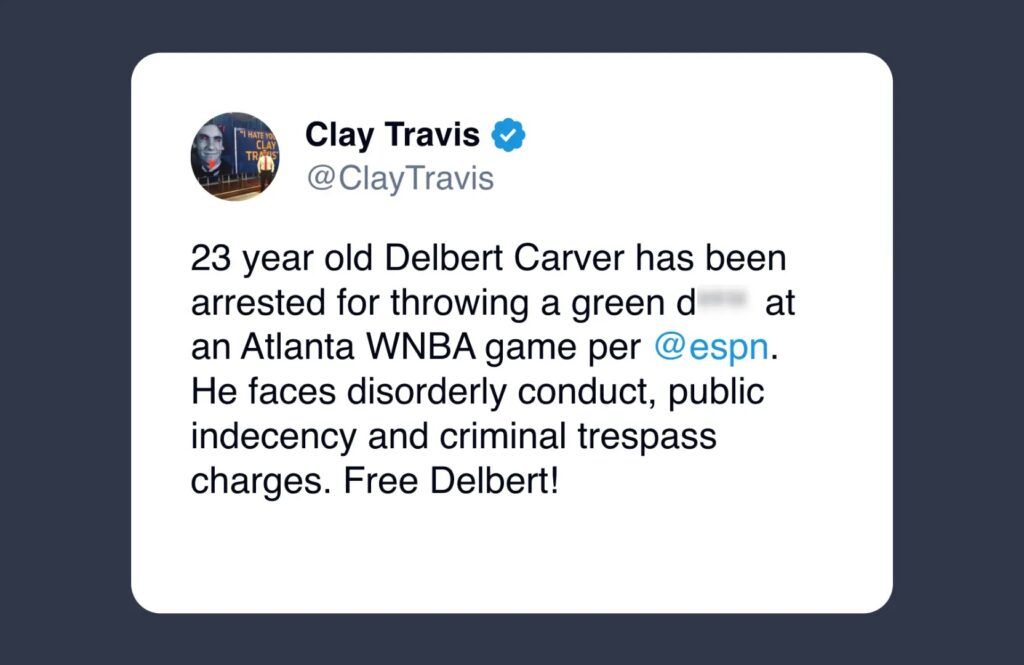
A 23-year-old male named Delbert Carver was booked into the Clayton County Jail at 7:42 p.m. Saturday, four days after the Atlanta attack, and was charged with disorderly conduct, public indecency, and criminal trespass, according to jail intake logs. He was released Sunday at 11:23 p.m. on undisclosed bail.
According to a report by ESPN citing a police affidavit from College Park police, Carter was at the game with friends, and told police “this was supposed to be a joke and this joke [was] supposed to go viral.”
Oh, so it was all in good fun.
Clay Travis, a conservative talk show host on Fox, defended Carver, tweeting “Free Delbert” to his 1.3 million followers on the social media platform X.
The sentiment wasn’t universally embraced. One follower clapped back: “Standing up for dudes chucking dicks at a women’s basketball game is not the hill to die on.”
On Tuesday, an 18-year-old man in Phoenix was arrested immediately after chucking a green dildo from the stands toward the court. He missed his mark and hit an older male fan and his nine year old daughter, for which he was charged with assault.
The lesson: Hit a man or a child with a fake dick, it’s assault. Hit a woman, play on.
Apart from debate over the criminality of the attacks, there’s something culturally significant at work. You don’t have to be Freud to see the psychosexual underpinnings when a young man throws a neon green penis onto the court of a women’s professional athletic contest.
First, there’s the discomfort over dildos.
The media likes the term “sex toy,” or the even more opaque reference to an “object.” I don’t know why the typically male sports writers and editors are uncomfortable calling them dildos, though I could hazard a guess.
It’s not just the language, though. At the game in Atlanta, the TV cameras were quick to zoom in on something being thrown onto the court, only to cut-away even faster when it became clear that it was a dildo. (Imagine the shrieking by the production crew in the control room.) A law enforcement official used a towel to pick up the object. (Who knows where it had been!?) She then carried it off the court in feigned non-chalance.
The pearl-clutching and prissy approach to evidence collection only serves to enhance the titillating effect, as well as encouraging repetition. Can’t imagine many other objects thrown onto the court producing the same shock and awe.
There’s reason for that. The W is the most publicly inclusive of LGBTQ+ of any of the professional sports. Any doubts? Check out the StudBudz live stream from All-Star weekend.
The social media snark reflects this, and not always in a positive way. There were more than a few self-impressed trolls who sneered not so subtly about the dildo: Thrown out or fell out?
But it’s not just queerness. It’s also some pretty passive aggressive toxic masculinity — using a lime green silicone repilca of male genitalia as a symbol of power.
Men are generally overly impressed with their anatomy in contrast to women, and for a young man who’s pre-frontal cortex is still developing, throwing a fake penis at women may seem like a hilarious assertion of superiority in gender and sex.
There was clearly intentions behind the acts. Not a lot of men walk around with a dildo in their pocket. And since bags are searched or banned entirely from almost all sports venues, it seems this particular object would have to have been concealed somewhere on the perpatrators’ bodies. Then they had to be whipped out and used as weapons to specifically assault women. If you doubt the semiotics here, ask your self why a dildo? Why not a plastic water bottle or a beer?
In Los Angeles, the dildo hit Indiana Fever guard Sophie Cunningham in the leg, causing her to startle. Sparks guard Kelsey Plum stepped up and disdainfully kicked it to the sideline, where security officials, again armed with towels, collected the offending chunk of molded silicone.
Plum later in a post-game news conference brushed off the sexual harassment in the same way women have for ages. “I thought too we did a great job, Indiana included, just playing on. Like, don’t give it any attention,” Plum told reporters. “And the refs, really appreciated them too, like, ‘hey let’s go.’”
There’s a whole theory in sports managment that troublemakers shouldn’t be given a public platform. For example, if someone jumps out of the stands and runs onto the field of a football game, the broadcasters tend not to put a camera on what’s happening on the field, so as not to encourage repeats.
But this instance is different. It’s throwing an object that could do serious harm and it should be treated not as a drunken sprint across the pitch, but as a criminal assault on the players. The game should be stopped and the offender identified and kicked out of the arena before play is allowed to commence. The culprit should be turned over to authroitiies and prosecuted for felony assault. The league should ban them culprits for life from the arena.
If that seems like over-reaction, flip the scenario and imagine someone throwing a dildo onto the floor of a men’s professional basketball game.
I’m sure none of those athletes would have kicked it to the sideline and said, “Play on.”
The real question, though, remains: Where is WNBA president Cathy Englebert in all of this?.