
A hissy fit at the NCAA tournament may be the best argument for a new standard in coaching women
Geno Auriemma’s tantrum at the NCAA Women’s Final Four basketball tournament prompted a friend of mine to broach the question of whether men should even be coaching women’s teams.
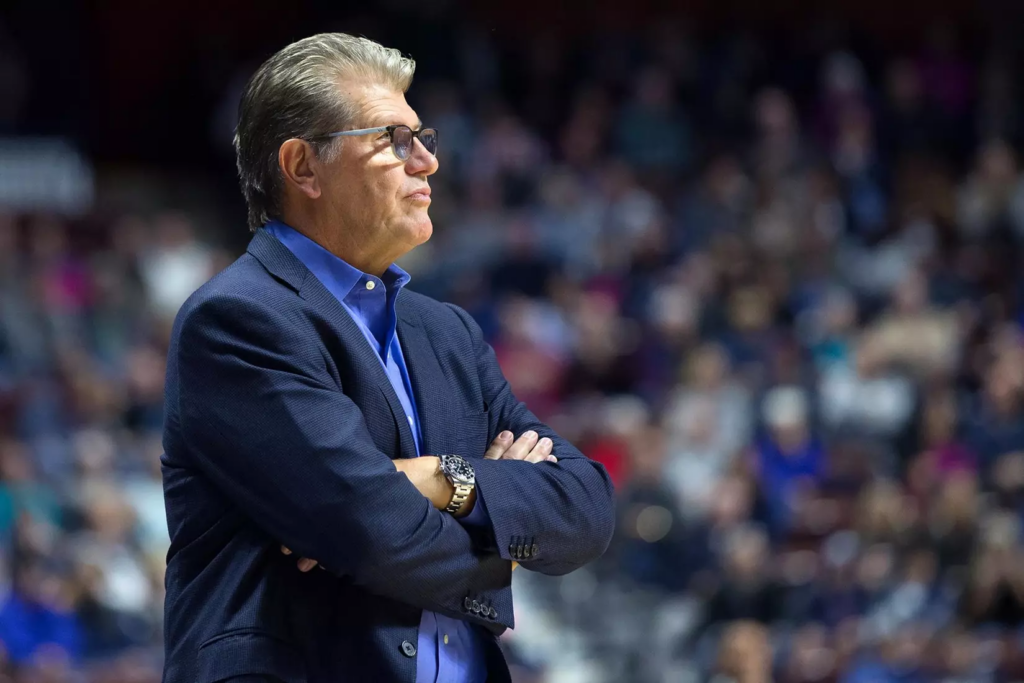
Photo: University of Connecticut.
While an outright ban seems problematic — equal rights, merit, bias, etc. — there is no good reason why men should be coaching the vast majority of NCAA women’s teams.
Instead, how about setting a new standard: The number of men coaching an NCAA women’s team in a particular sport cannot exceed the number of women coaching an NCAA men’s team in that sport.
For basketball, that magical number would be zero.
While not one woman coaches a men’s Division 1 basketball team, the number of male coaches approaches 60 percent, according to a 2023 report by The Institute for Diversity and Ethics in Sport at Central Florida University. The report also showed that men also hold about half of the assistant coaching jobs in the women’s game.
The gender gap in basketball is narrower than for every other sport, save softball and lacrosse. According to the NCAA’s own data, women head coaches lead fewer than 25% of the 20,341 total NCAA men’s & women’s teams across all divisions.
The paucity of women coaches in women’s sports is “the most depressing statistic that we report every year,” TIDES director Richard Lapchick told the Associated Press.
Fifty-four years ago, when Title IX was enacted, 90 percent of women’s teams were coached by women. that
With the increased participation by female athletes and more money directed at women’s sports, men suddenly saw an opportunity. Auriemma, who has coached womens basketball at the University of Connecticut since 1985, is paid $3.4 million a year. He was the highest paid women’s coach in history, until last year, when South Carolina coach Dawn Staley renegotiated her contract after winning a third national championship.
But neither gender nor salary can predict success.
Since 2000, eight different women have coached basketball teams to national championships. most of them multiple times. Auriemma is one of only two men to do so . (To Auriemma’s credit he’s won it 12 times, surpassing even the ten titles by UCLA men’s coaching legend John Wooden.)
We measure the worth of coaches by win-loss records, but is that the best standard?
Some of the best coaches can be real assholes: Bobby Knight at Indiana; Woody Hayes at Ohio State University; Billy Martin at the New York Yankees; Bobby Hurley at the University of Connecticut. This year the University of Virginia’s Amaka Agugua-Hamilton and University of Pittsburgh’s Tory Verdi were fired amid allegations of a toxic locker room.
Auriemma considers himself an “old school” coach.
In part, such descriptions are an attempt to explain meltdowns like the one Auriemma had after Connecticut lost badly in the semi-final to South Carolina. It’s an attitude fueled by hubris and tinged with the sort of subtle misogyny that many women, especially black women, recognized immediately.
As a general rule, that male-centric model is not how women choose to lead.
Earlier in the tournament, Maryland head coach Brenda Frese went viral for her positive intensity on the sideline with one of her star players, Oluchi Okananwa, who was struggling in the game. As Okananwa came to the sideline, Frese got in her face and at full volume said, “I believe in you, but you have got to want this moment.” It became a teachable moment nationally, a lesson in “hard” coaching from compassion and positivity rather than pride and power.
This approach, which only seems new, is about more than demeanor or style.
A focal point of Emma Hayes since she took over the US Women’s soccer team has been to approach coaching women through a “female lens” rather than mimicking methods used in coaching male athletes.
The differences, she points out, are physcial, including dealing with hormonal fluctuations through menstruation and pregnancy, as well as establishing a holistic approach that values emotional intelligence, childcare, and finding joy in the game. Women are not just small men, Hayes has said on numerous occasions.
The legendary Muffet McGraw, who won two national championships coaching Notre Dame’s women’s basketball team, famously said she would never hire another male assistant coach — remarks that scorched the internet at the time.
The comments came at a news conference ahead of the 2019 Woemn’s Final Four in Tampa, Fla. McGraw said she hadn’t had a male on her staff since 2012. She felt it was incumbent on her to provide those opportnites to women coaches and grow the women’s game. “We don’t have enough female role models,” she told reporters. “We don’t have enough visible women leaders. We don’t have enough women in power.”
The Irish were set to face Connecticut in the semifinals of that tournament, and Auriemma didn’t hesitate with his hot take when asked about McGraw’s remarks: “I hope she sends a thank you to all those guys that used to be on her staff that got her all those good players that won a championship.”
All of that still leaves open the question of whether men should coach women.
We spend an inordinate amount of time talking about protecting women from the intrusion of men on the field of play, We seem hardly concerned at all about protecting women from the intrusion of men on the sidelines.
If we value ensuring women have a fair opportunity in sports, how do we account for the gaping disparity in men coaching women.