At FIBA, men competing against women is just fine

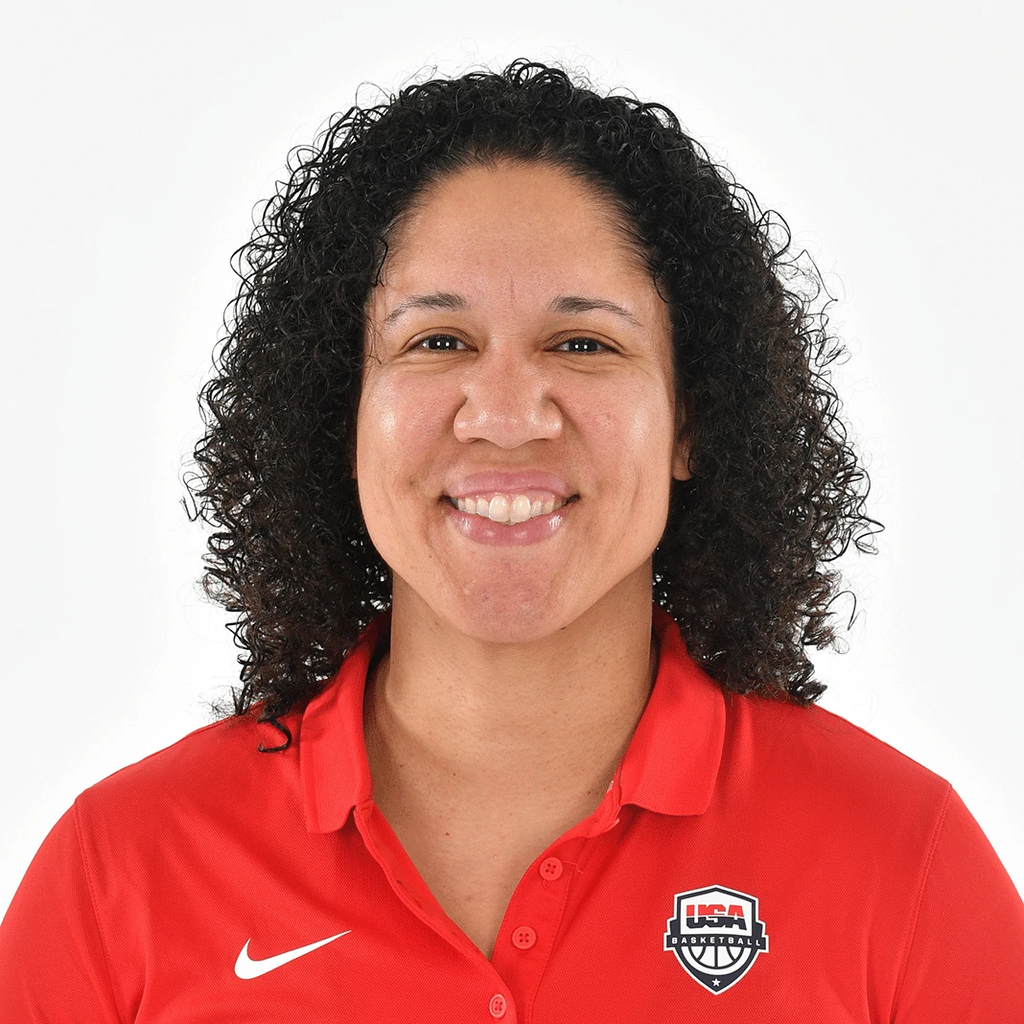
Kara Lawson, head coach US women’s national team

If you’ve been watching the FIBA world cup women’s basketball tournament this week, you might have noticed something on the sidelines.

Just four of the sixteen teams have women head coaches — Australia, Czechia, Nigeria and the United States.

In the world of women’s sports — where there is so much emphasis on protecting female players from having to compete against male players on the court  — few people seem bothered that men continue to usurp women in sideline roles on virtually every national team around the world.

And, not parentheically, the greatest threat to women athletes historically has been gtom male coaches.

The gender imbalance among coaches reaches down the bench. Five of the teams in the tournament in Berlin have entirely male coaching staffs. No team has an all female staff.

Of the sixteen first assistant coaches, just three are women. 

The only place where women outnumber men is as an “accompanying coach,” the lowest level of personnel on the bench who, by FIBA definitions, are allowed on the bench to serve “functional” roles as assistants, team managers, physios and statisticians.

Of the 51 coaches listed on FIBA rosters, 60% are men

That’s an utter disgrace.

Lest you think the coach’s nationality matters in an international tournament, it doesn’t. American Corey Gaines is coaching Japan and American Mike Thibault is coaching Belgium. 

And if you think there aren’t enough women to fill these posts, you’re just not paying attention.

Women are more than qualified to coach these teams. There are any number who would have been delighted to step up and establish their bona fides by leading a national team through this prestigious tournament.

The United States is the most female forward coaching staff in Berlin.

The US is Led by Kara Lawson, the head coach at Duke, and first assistant coach Stephanie White, the head coach of the Indiana Fever. The accompanying coaches are Natalie Nakase, head coach of the Golden State Valkyries; Nate Tibbets, head coach of the Phoenix Mercury; and Jose Fernandez, head coach of the Dallas Wings.

Freedom to troll for political gain

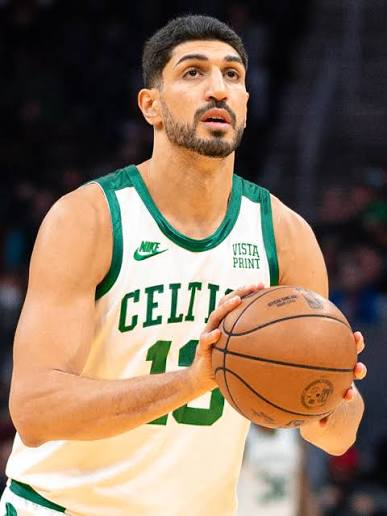
Enes Kanter Freedom via Wikipedia

Enes Kanter wasn’t always an attention-seeking troll.

Nine years ago, the former NBA player sought permanent resident status in the U.S. after Turkiye revoked his passport over his outspoken criticism of the Erdogan regime. He became a U.S. citizen in 2021 and changed his legal name to Enes Kanter Freedom.

“In my first weeks as a U.S. citizen, I’ve experienced the full richness and contradictions of what it means to be an American,” Kanter said in an oped published by Time magazine. “I changed my last name to Freedom, and then made the most of that newfound freedom by continuing to advocate for the oppressed and speaking truth to power at every opportunity.”

Kanter burnished his reputationas an advocate for human rights, speaking out against abuses in China, particularly the treatment of Uyghurs, as well as abuses in Turkiye, Russia, Iran, North Korea, and Venezuela. He criticized Nike for exploiting forced labor overseas and LeBron James for choosing “money over morals” by endorsing Nike. 

Kanter marched in support of the Black Lives Matter movement here in the U.S., even speaking publicly at a rally in Boston. He told the Guardian UK newspaper ithat athletes should use their platforms “to spread good, and to spread the truth.”

You might say he was “woke.”

Not so anymore. 

The protector has become the bully. 

Worse, he’s trying to gaslight the world into thinking he is still advocating for human rights and personal freedom.

Kanter showed up an a WNBA game in Chicago between the Sky and the Indiana Fever over the weekend wearing a shirt with a psuedo-definition of “woman” printed on the front. His publicly stated goal is to call out the league for its policy on transwomen, even though no transwoman has ever played in the league. 

Kanter, a 6-10 man with a meticulously grommed beard, says he now identifies as female and will register for the WNBA draft next year, even prediciting he would be a top choice. 

It’s all a calculated effort to rage bait the very female athletes he says he wants to protect from the mal-intent of men.

But why?

Kanter wants a public platform and the media spotlight.

He was candid last year on Fox news when he said he plans run for Congress in 2028, the point at which he meets the Constitutional requirement of being a citizen for at least seven years. He said he is likely to run in Florida, though he ostensibly lives in Oklahoma and has played in New York, Boston, Salt Lake City, Houston, and Portland 

His politics have also shifted.

In previous years, he invoked neutrality on political partisanship and said his focus was solely human rights. 

Over the past few years, however, Kanter has aligned himself with right-wing platforms and conservative political agendas. He attended President Trump’s 2026 State of the Union address as a guest of House Speaker Mike Johnson.

He is working directly with the America First Policy Institute, a policy think tank aligned with Trump and the MAGA movement. Representatives of the group accompanied him to the game and took note of the ruckus he caused by tweeting, “Let Freedom Play.”

Play, indeed. This once serious advocate for human rights has become a shadow of his former self and is departe to find the limelight once again.

It’s too bad he wants to do so at the expense of women.

Fairness, equity and male coaches

A hissy fit at the NCAA tournament may be the best argument for a new standard in coaching women

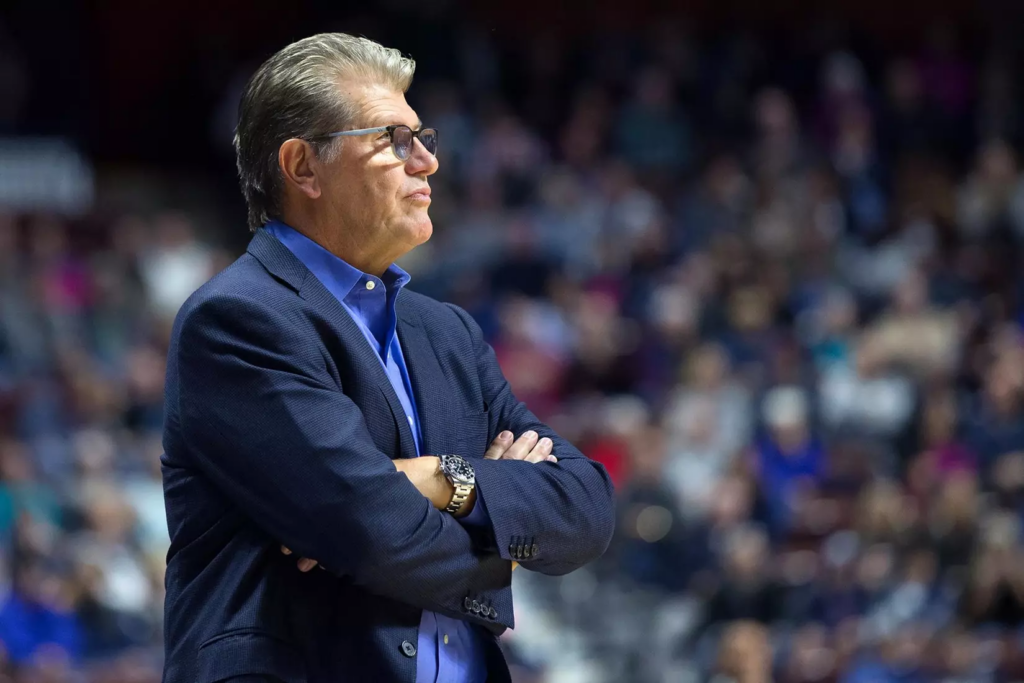
Geno Auriemma’s tantrum at the NCAA Women’s Final Four basketball tournament prompted a friend of mine to broach the question of whether men should even be coaching women’s teams.

Coach Geno Auriemma.
Photo: University of Connecticut.

While an outright ban seems problematic — equal rights, merit, bias, etc. — there is no good reason why men should be coaching the vast majority of NCAA women’s teams. 

Instead, how about setting a new standard: The number of men coaching an NCAA women’s team in a particular sport cannot exceed the number of women coaching an NCAA men’s team in that sport.

For basketball, that magical number would be zero.

While not one woman coaches a men’s Division 1 basketball team, the number of male coaches approaches 60 percent, according to a 2023 report by The Institute for Diversity and Ethics in Sport at Central Florida University. The report also showed that men also hold about half of the assistant coaching jobs in the women’s game.

The gender gap in basketball is narrower than for every other sport, save softball and lacrosse. According to the NCAA’s own data, women head coaches lead fewer than 25% of the 20,341 total NCAA men’s & women’s teams across all divisions.

The  paucity of women coaches in women’s sports is “the most depressing statistic that we report every year,” TIDES director Richard Lapchick told the Associated Press.

Fifty-four years ago, when Title IX was enacted, 90 percent of women’s teams were coached by women. that

With the increased participation by female athletes and more money directed at women’s sports, men suddenly saw an opportunity. Auriemma, who has coached womens basketball at the University of Connecticut since 1985, is paid $3.4 million a year. He was the highest paid women’s coach in history, until last year, when South Carolina coach Dawn Staley renegotiated her contract after winning a third national championship.

But neither gender nor salary can predict success.

Since 2000, eight different women have coached basketball teams to national championships. most of them multiple times. Auriemma is one of only two men to do so . (To Auriemma’s credit he’s won it 12 times, surpassing even the ten titles by UCLA men’s coaching legend John Wooden.)

We measure the worth of coaches by win-loss records, but is that the best standard?

Some of the best coaches can be real assholes: Bobby Knight at Indiana; Woody Hayes at Ohio State University; Billy Martin at the New York Yankees; Bobby Hurley at the University of Connecticut. This year the University of Virginia’s Amaka Agugua-Hamilton and University of Pittsburgh’s Tory Verdi were fired amid allegations of a toxic locker room.

Auriemma considers himself an “old school” coach.

In part, such descriptions are an attempt to explain meltdowns like the one Auriemma had after Connecticut lost badly in the semi-final to South Carolina. It’s an attitude fueled by hubris and tinged with the sort of subtle misogyny that many women, especially black women, recognized immediately.

As a general rule, that male-centric model is not how women choose to lead.

Earlier in the tournament, Maryland head coach Brenda Frese went viral for her positive intensity on the sideline with one of her star players, Oluchi Okananwa, who was struggling in the game. As Okananwa came to the sideline, Frese got in her face and at full volume said, “I believe in you, but you have got to want this moment.” It became a teachable moment nationally, a lesson in “hard” coaching from compassion and positivity rather than pride and power.

This approach, which only seems new, is about more than demeanor or style.

A focal point of Emma Hayes since she took over the US Women’s soccer team has been to approach coaching women through a “female lens” rather than mimicking methods  used in coaching male athletes. 

The differences, she points out, are physcial, including dealing with hormonal fluctuations through menstruation and pregnancy, as well as establishing a holistic approach that values emotional intelligence, childcare, and finding joy in the game. Women are not just small men, Hayes has said on numerous occasions. 

The legendary Muffet McGraw, who won two national championships coaching Notre Dame’s women’s basketball team, famously said she would never hire another male assistant coach — remarks that scorched the internet at the time.

The comments came at a news conference ahead of the 2019 Woemn’s Final Four in Tampa, Fla. McGraw said she hadn’t had a male on her staff since 2012. She felt it was incumbent on her to provide those opportnites to women coaches and grow the women’s game. “We don’t have enough female role models,” she told reporters. “We don’t have enough visible women leaders. We don’t have enough women in power.”

The Irish were set to face Connecticut in the semifinals of that tournament, and Auriemma didn’t hesitate with his hot take when asked about McGraw’s remarks: “I hope she sends a thank you to all those guys that used to be on her staff that got her all those good players that won a championship.”

All of that still leaves open the question of whether men should coach women.

We spend an inordinate amount of time talking about protecting women from the intrusion of men on the field of play, We seem hardly concerned at all about protecting women from the intrusion of men on the sidelines.

If we value ensuring women have a fair opportunity in sports, how do we account for the gaping disparity in men coaching women.

Flying sex toys at the WNBA

It’s raining dildos at women’s professional basketball games.

Five times in the past week someone at a WNBA game has thrown a dildo onto the court during the game. It’s happened in Los Angeles, Chicago, Phoenix, New York, and Atlanta. 

NBC referred to the incident at Crypto.com Arena in Los Angeles as a “vulgar prank.” 

Let’s be clear. It’s not a prank.

“It’s ridiculous. It’s dumb. It’s stupid,” Sparks coach Lynne Roberts told reporters after the game. “It’s also dangerous and players’ safety is number one. Respecting the game. All those things. I think it’s really stupid. That’s all I’m going to say.”

Amen.

However, the mainstream media seems less interested in the seriousness of the incidents and more interested in publishing SEO headlines about “sex toys” that generate page views. TMZ Sports decided the disrespect was directed at adult toy companies rather than players. Fine. That’s what they do..

To be clear, these are assaults. To describe them as “pranks” with “sex toys” is to minimize these attacks on women in a way that feels all too familiar. 

For comparison, if someone threw a water bottle at a law enforcement officer, how many news outlets would choose to describe that as a prank rather than an assualt?

One person has been arrested, so far. 

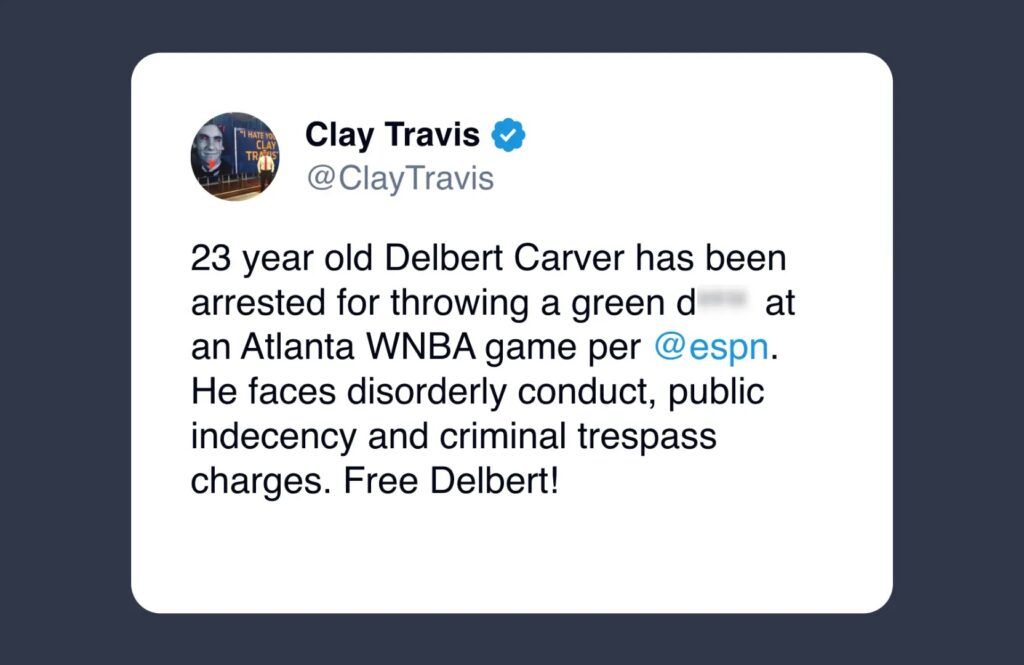
A 23-year-old male named Delbert Carver was booked into the Clayton County Jail at 7:42 p.m. Saturday, four days after the Atlanta attack, and was charged with disorderly conduct, public indecency, and criminal trespass, according to jail intake logs. He was released Sunday at 11:23 p.m. on undisclosed bail.

According to a report by ESPN citing a police affidavit from College Park police, Carter was at the game with friends, and told police “this was supposed to be a joke and this joke [was] supposed to go viral.”

Oh, so it was all in good fun. 

Clay Travis, a conservative talk show host on Fox, defended Carver, tweeting “Free Delbert” to his 1.3 million followers on the social media platform X.  

The sentiment wasn’t universally embraced. One follower clapped back: “Standing up for dudes chucking dicks at a women’s basketball game is not the hill to die on.”

On Tuesday, an 18-year-old man in Phoenix was arrested immediately after chucking a green dildo from the stands toward the court. He missed his mark and hit an older male fan and his nine year old daughter, for which he was charged with assault.

The lesson: Hit a man or a child with a fake dick, it’s assault. Hit a woman, play on.

Apart from debate over the criminality of the attacks, there’s something culturally significant at work. You don’t have to be Freud to see the psychosexual underpinnings when a young man throws a neon green penis onto the court of a women’s professional athletic contest.

First, there’s the discomfort over dildos. 

The media likes the term “sex toy,” or the even more opaque reference to an “object.” I don’t know why the typically male sports writers and editors are uncomfortable calling them dildos, though I could hazard a guess. 

It’s not just the language, though. At the game in Atlanta, the TV cameras were quick to zoom in on something being thrown onto the court, only to cut-away even faster when it became clear that it was a dildo. (Imagine the shrieking by the production crew in the control room.) A law enforcement official used a towel to pick up the object. (Who knows where it had been!?) She then carried it off the court in feigned non-chalance. 

The pearl-clutching and prissy approach to evidence collection only serves to enhance the titillating effect, as well as encouraging repetition. Can’t imagine many other objects thrown onto the court producing the same shock and awe.

There’s reason for that. The W is the most publicly inclusive of LGBTQ+ of any of the professional sports. Any doubts? Check out the StudBudz live stream from All-Star weekend.

The social media snark reflects this, and not always in a positive way. There were more than a few self-impressed trolls who sneered not so subtly about the dildo: Thrown out or fell out?

But it’s not just queerness. It’s also some pretty passive aggressive toxic masculinity — using a lime green silicone repilca of male genitalia as a symbol of power.

Men are generally overly impressed with their anatomy in contrast to women, and for a young man who’s pre-frontal cortex is still developing, throwing a fake penis at women may seem like a hilarious assertion of superiority in gender and sex.

There was clearly intentions behind the acts. Not a lot of men walk around with a dildo in their pocket. And since bags are searched or banned entirely from almost all sports venues, it seems this particular object would have to have been concealed somewhere on the perpatrators’ bodies. Then they had to be whipped out and used as weapons to specifically assault women. If you doubt the semiotics here, ask your self why a dildo? Why not a plastic water bottle or a beer?

In Los Angeles, the dildo hit Indiana Fever guard Sophie Cunningham in the leg, causing her to startle. Sparks guard Kelsey Plum stepped up and disdainfully kicked it to the sideline, where security officials, again armed with towels, collected the offending chunk of molded silicone.

Plum later in a post-game news conference brushed off the sexual harassment in the same way women have for ages. “I thought too we did a great job, Indiana included, just playing on. Like, don’t give it any attention,” Plum told reporters. “And the refs, really appreciated them too, like, ‘hey let’s go.’”

There’s a whole theory in sports managment that troublemakers shouldn’t be given a public platform. For example, if someone jumps out of the stands and runs onto the field of a football game, the broadcasters tend not to put a camera on what’s happening on the field, so as not to encourage repeats.

But this instance is different. It’s throwing an object that could do serious harm and it should be treated not as a drunken sprint across the pitch, but as a criminal assault on the players.  The game should be stopped and the offender identified and kicked out of the arena before play is allowed to commence. The culprit should be turned over to authroitiies and prosecuted for felony assault. The league should ban them culprits for life from the arena.

If that seems like over-reaction, flip the scenario and imagine someone throwing a dildo onto the floor of a men’s professional basketball game.

I’m sure none of those athletes would have kicked it to the sideline and said, “Play on.”

The real question, though, remains: Where is WNBA president Cathy Englebert in all of this?.